
Professional development: How to stay ahead in a fast-changing subject
What does great training for computing teachers look like?
High-quality professional development (PD) is one of the most effective ways to improve your students’ outcomes, and participating in PD is a core part of being a teacher. By changing and refining your teaching practices, you can create a direct, positive impact on the young people we teach.
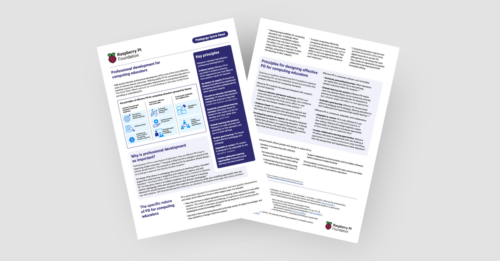
In this blog, we share our new professional development Quick Read, which you can download for free to:
- Find practical tips for how to use and design effective professional development opportunities
- Read a summary of the research behind effective PD
The unique impact of professional development for computer science educators
Professional development is vital for anyone teaching computing. In many subjects, the curriculum stays the same for decades. Computer science, however, can change quickly — as with the development of new technologies such as AI and quantum computing, and new hardware — and PD can help you stay up to date.

Another challenge is that many educators who teach computing are not necessarily subject specialists. So educators often benefit from building their own subject knowledge and learning new computing-specific pedagogical approaches through PD.
What makes effective professional development?
Drawing on academic research and our own expertise, we’ve identified several key principles that make professional development effective for computer science educators:
- Learner-focused and research-informed: PD should be based on evidence and equip you with the skills and confidence to make real changes in your practice
- Sustained and actionable: The best outcomes happen when you can select your own learning pathways and you’re given the time to test, adapt, and reflect on new approaches
- Collaborative and contextual: Sharing ideas and new ways of thinking with other educators in a low-stakes environment can help you and your peers benefit from different perspectives and experiences
There may be factors that influence your teaching that you have little control over: you might teach computing as a standalone subject, or you may be required to weave computer science into other lessons across the curriculum. Or you might be working with older devices or limited internet access, all of which have an impact on your practice.
Effective PD should recognise these realities, and offer practical tools that work for your specific classroom and students.
How to find or design PD for computing educators
You can use the principles in our latest Quick Read when you’re looking for your next training course or if you are designing a session for your team. The full list of principles is available in our Quick Read, but here are some ideas for you to consider:
- Focus on small, manageable changes: Rather than trying to overhaul your entire teaching practice at once, reflect on one approach at a time and adapt it as necessary before moving on to the next
- Encourage low-stakes rehearsal: Practise new techniques with peers before implementing them in a live lesson
- Align with school priorities: Ensure your self-directed learning also meets the wider needs of your department or school
You can read more about the principles of effective PD in our Quick Read.
The benefits of professional development
Potential benefits for teachers:
- Provides a clear structure for updating your subject knowledge and teaching methods
- Helps you feel more confident teaching
- Allows you to take ownership of your career journey and focus on what matters most to your students
Potential benefits for learners:
- Improved learning outcomes through:
- Higher quality lessons
- More engaging lessons
- Lessons better suited to their individual needs
Our new Quick Read shares tips on how to best use these principles in your setting.




No comments
Jump to the comment form