
Bring AI literacy into every classroom with our new themed resources
Artificial intelligence (AI) is already part of young people’s everyday lives, from the content recommended to them on social media to the generative AI tools they increasingly encounter. But AI technologies are also being used to tackle challenges in the wider world, from forecasting floods to monitoring our environment.
That’s why we believe AI literacy shouldn’t sit within a single subject. Young people need opportunities to explore how AI works, where it is used, and the questions it raises across the curriculum.
To address this, we created a new collection of free themed Experience AI resources, designed to make it easier for educators to bring AI literacy into the subjects and topics they already teach. The resources include those co-developed by the Raspberry Pi Foundation and Google DeepMind, alongside those developed independently by the Raspberry Pi Foundation, including two units created with support from our partner, Digital Moment.
Explore AI through the issues that matter
When we began developing these resources, we initially explored creating materials specifically for individual curriculum subjects. But through conversations with educators and our partners around the world, we learnt that a more flexible approach could be much more useful.
Curricula differ between countries, schools, and age groups, and AI technologies rarely fit neatly within traditional subject boundaries. The same technology can raise scientific, geographical, social, creative, and ethical questions.
So rather than assigning each resource to a particular subject, our new resources are organised around broad themes, including the environment, critical thinking, and ethics.
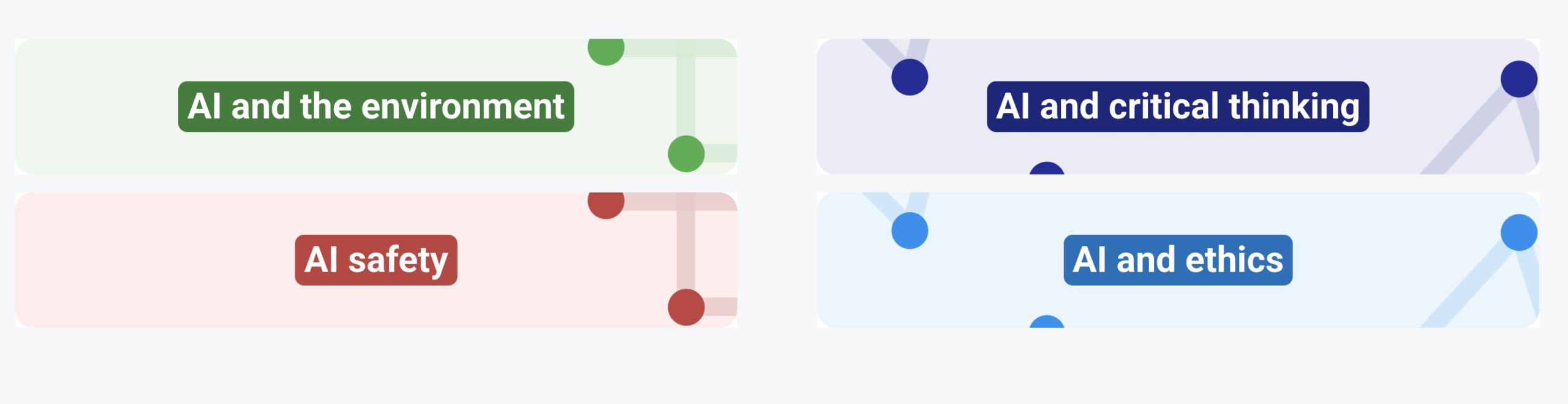
The resources include:
- Flood forecasting, a lesson that explores how AI tools can be used to predict flooding
- AI and social media, a unit that helps young people investigate how their online behaviour influences the content they are shown
- AI detectives: The case of the clever claim, an activity that develops critical thinking about AI tools and the claims made about them
Designed for learners aged 8 to 16, the resources can be used in different subjects and adapted by educators to suit their own classroom context.
That flexibility is important. We want educators to be able to introduce meaningful AI literacy without feeling that they need to become AI specialists or find space for an entirely new subject in an already busy curriculum.
AI literacy across the curriculum
The need for this approach is increasingly recognised by subject experts.
Dr Becky Kitchen, Head of Professional Development at the Geographical Association, highlighted the importance of giving young people opportunities to engage critically with AI technologies as part of their wider learning:

“Pupils are increasingly coming into contact with AI and so it’s vital that they are taught how to harness its power in an effective and critical way. Developing resources across the curriculum to embed this knowledge, understanding, and use is critical.”
After reviewing the new resources, she added:
“These resources are outstanding. They develop pupils’ geographical knowledge while simultaneously exploring the role that AI can have in a meaningful and concrete way.”
The connections extend well beyond geography.
Professor Geoff Cox, Professor of Art and Computational Culture at London South Bank University, emphasised the role that arts and humanities subjects can play in developing a richer understanding of AI technologies:
“If AI literacy is left solely to STEM subjects or computer science, we lose the opportunity to ask deeper human, cultural, and ethical questions — questions that art is uniquely equipped to explore.”
He also highlighted the value of combining different ways of learning:
“The resources move between visual analysis, practical activity, and critical reflection, recognising that only in combination can AI literacy be developed effectively.”
These perspectives reflect an important principle behind the collection. AI literacy isn’t simply about knowing how a technology works. It is also about being able to question it, understand its applications and limitations, and consider its impact on people, communities, and the world.
Tested in real classrooms
Before launching the resources more widely, earlier this year we collaborated with our partner, Digital Moment, to give educators in Canada the opportunity to test some of them with their students. Their experiences helped us understand not only how the resources worked in practice, but also where they could fit naturally into existing teaching.
As Indra Kubicek, CEO of Digital Moment, explains:
“Educators play a critical role in helping students understand and think critically about the use of AI and its implications across a wide range of subjects. Building the next generation of creators, builders, and innovators who will shape the future of AI starts with AI education in the classroom.”
One of the educators who took part was Grade 8 teacher Sandra Theobald, who tested our AI and social media activity. Before the lesson, she expected her students, who were already regular social media users, to be familiar with many of the ideas.

While they did have a good background knowledge, the activity prompted them to make new connections between their own behaviour, the data they generate, and the content they are shown as a result of the algorithms presented to them.
Students were able to explore the ideas themselves, with Sandra taking more of a supporting role. She found that they came away feeling more confident about understanding how their interactions with social media affect what they see, and keen to share what they had discovered with their families.
For educators who may feel unsure about introducing AI tools in their classroom, Sandra’s advice is to simply give it a go, rather than waiting until feeling like an expert:
“My advice is to start small and seek out trusted resources and experts in AI education. Partner with another educator so you can explore and learn together. There is so much information available that it can feel overwhelming, so take it one step at a time. Learn alongside your students and build your confidence as you go.”
A powerful and easy resource for teachers
Canadian educator Colin McKenzie also used the AI and social media unit with his Grade 7 and 8 classes.

Using Somekone, a closed social media simulation for the classroom, his students created accounts and explored how their behaviour affected the content the system recommended.
The experience felt familiar enough to capture their attention, but gave them an opportunity they wouldn’t normally have when using a real social media platform: to examine what was happening behind the scenes.
Students reflected on their interests and choices and then used data on their own behaviour to understand how that behaviour affected what they were shown. Colin found that students were eager to return to the activity each day to discover what would happen next.
Crucially, he also found it straightforward to incorporate the activity into his existing teaching rather than having to significantly change his plans.
“I think this is a powerful and easy resource for teachers to use in the classroom. It is easy to set up and navigate, and it ties in well with curriculum areas around online usage, especially with how prominent AI is becoming in our educational lives.”
For Colin, the activity provided a practical way to connect AI literacy with what his students had already learnt about online safety and evaluating information. It also helped students recognise that the content they encounter online isn’t simply appearing by chance: their own actions can influence the content recommended to them by AI-driven systems.
The experience was valuable enough that Colin plans to make the unit part of his teaching each year.
Giving educators flexibility
Feedback like this has reinforced why flexibility is central to our approach.
A lesson about flood forecasting might support learning in geography or science. Exploring AI-generated content could lead to discussions in art, media literacy, humanities, or computing. An activity investigating social media algorithms can connect AI literacy with online safety, critical thinking, and digital citizenship.
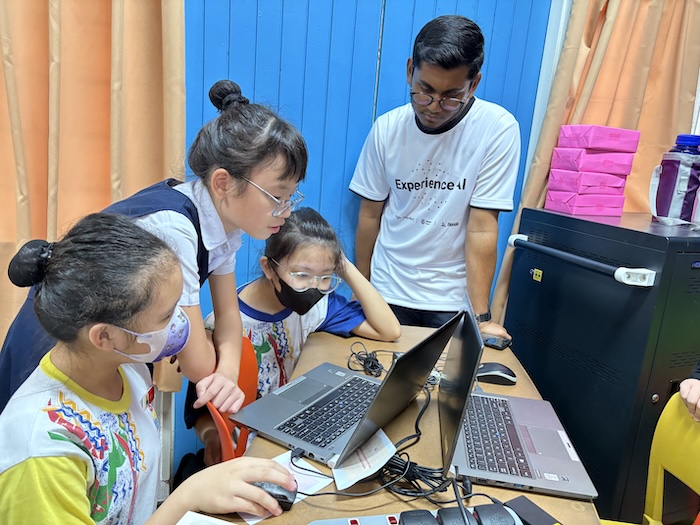
Most importantly, these things provide opportunities for students to encounter AI literacy in different contexts and recognise that understanding AI is relevant far beyond the computing classroom.
AI literacy belongs in every classroom
AI technologies will continue to change. The contexts in which young people encounter them will change too.
Our aim isn’t to prepare students for one particular AI tool or moment in time. It’s to help them develop the knowledge and critical thinking skills they need to understand all kinds of AI technologies, question them, and make informed decisions about them.
Educators shouldn’t need to be computer science teachers, or AI experts, to do that.
By creating flexible resources that connect AI with subjects and issues young people are already exploring, we hope to make it easier for more educators to bring AI literacy into their classrooms.
Explore the new themed Experience AI resources and discover a starting point for your learners.
We’d like to say a big thank you to our global partner, Digital Moment, for their support in trialling these new resources with educators and learners in Canada.



No comments
Jump to the comment form