
Join the UK Bebras Challenge 2026
The UK Bebras Challenge, the nation’s largest computing challenge, is back!
Last year, more than 526,000 students from across the UK took part, tackling fun and thought-provoking puzzles that introduce key ideas in computational thinking with no extra preparation needed.
Read on to learn how your school can get involved.
What is the UK Bebras Challenge?
The UK Bebras Challenge is a free-to-enter annual challenge that is designed to spark interest in both computational thinking and computer science among students aged 6 to 19. The 45-minute challenge is accessible to everyone, offering age-appropriate but challenging interactive tasks for students at different levels, including a tailored version for secondary students with severe sight impairments.
The tasks are designed to give every student the opportunity to showcase their potential and all participating students receive a certificate. There are also certificates based on performance within school and gold certificates based on national boundaries. With self-marking tasks and no text-based programming required, it’s easy to have your school participate in the UK Bebras Challenge.
“The UK Bebras challenge provides an engaging way for students to apply their problem-solving skills in a fun, competitive environment. It complements our coding curriculum, encouraging critical thinking and enhancing computational thinking,” – Jonathan Phillips from Hereford Cathedral School
Go deeper with Ada Computer Science
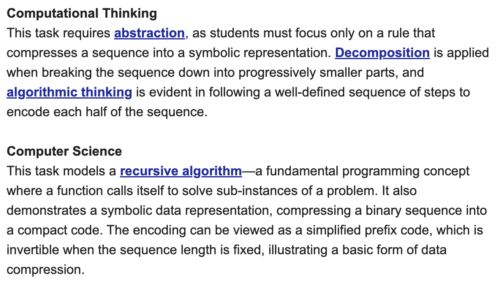
Each Bebras task’s background section is now linked to a related topic on the Ada Computer Science platform. Following the live challenge, teachers and students can explore ithe detailed explanation of the computer science concept behind each Bebras task, along with the computational thinking skills students may use to solve that task.
“We have thoroughly enjoyed delivering the UK Bebras Challenge at our school. It has been an invaluable resource and by participating in this exciting event, our students have been introduced to the world of computational thinking in a fun and engaging way. The challenges are designed to push students to think critically and creatively, developing essential problem-solving skills that are applicable both inside and outside of the classroom.” – Sharon Pendreigh from Brownedge St Mary’s Catholic High School
How do I get my school involved?
If you are either a UK school or teach a UK-based curriculum, then visit the UK Bebras website for more information and to register your school.
Once you’ve registered, you’ll get access to the entire UK Bebras set of questions from previous years, allowing you to create custom quizzes for your students to tackle at any time throughout the year. These quizzes are self-marking, and you can download your students’ results to keep track of their progress. The questions are perfect for enrichment activities, end-of-term quizzes, lesson starters, and even full lessons to develop computational thinking skills and promote computing concepts.
Register for free at bebras.uk/admin.
Have a go at one of our puzzles
Here’s a question we ran in 2018 for the Juniors group (ages 10 to 12). Can you solve it?
Park walk
This is the map of a park:
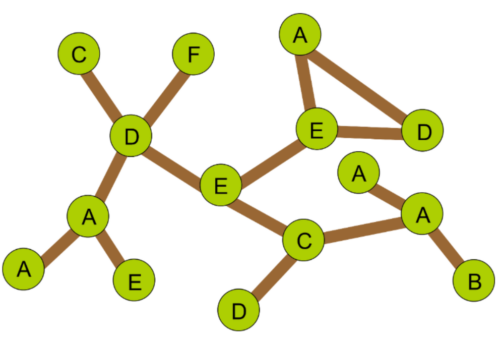
The green circles with letters represent the trees and the brown lines are paths. Note that some letters are used to label more than one tree. Walking from tree F to tree B can be described as F D E C A B.
Last Sunday two families walked in the park.
The Wilde family’s walk was B A A A C E D E E D A.
The Gilde family’s walk was F D C D A E A D E D A.
Both families started their walks at the same time.
Walking from one tree to another tree, down one path takes the same amount of time.
Question:
How many times did the two families meet at a tree?

Answer
They never met at any of the trees.
Explanation
Computer scientists often use graphs (and then they speak about vertices and edges instead of trees and paths connecting them).
Another interesting point about this task is the representation of the walks in the park. Despite the fact that some of the trees (vertices) are marked by the same letter, the walks that start from B or F can be unambiguously described by the sequence of letters along the walk. It means that one sequence of letters describes only one walk. It is because the neighbours of each tree (neighbours of tree X are the trees that are directly connected to X by a path) are always labeled with different letters. So if we know where we are at some moment of the walk and we see the next letter in the walk’s representation then there is no doubt which tree we should visit next.
This Bebras task was developed by the Bebras team in South Korea and refined by members of the international Bebras community.
In 1936, a Hungarian mathematician called Dénes Kőnig wrote the first ever textbook on graph theory. Today, graph theory is fundamental to computer science and in particular networking, operation research and data structures.
Did you get it right?

No comments
Jump to the comment form