
Not all explanations are equal: Social Explainable AI and Critical Computational Literacy
AI technologies, such as smart speakers or streaming recommendations, are becoming part of everyday life for children and teenagers. It’s therefore increasingly important to help young people understand not just how these systems work, but how to question them.

When AI systems generate outputs such as a recommendation, these outputs are often accompanied by an explanation. In our latest research seminar, Professor Dr. Dan Verständig (Goethe University Frankfurt, Center for Critical Computational Studies) spoke about how explanations are shaped by the people who write them, and only become meaningful when someone else makes sense of them. Dan introduced us to Social Explainable AI (Social XAI) and Critical Computational Literacy (CCL), and asked us to consider not just what an AI system explains, but for whom, why, and who benefits.
Why do we need explanations?
Dan opened with a deceptively simple question: why do we need explanations in the first place? His answer was that explanations provide orientation. They reduce uncertainty, and in doing so, they make our shared social world liveable. Explanations have evolved from Socratic dialogue, to the printed book, to the classroom, to today’s digital interfaces, and now to AI-generated explanations. But explanations have never been neutral conveyors of information. Dan illustrated this with a simple demonstration: he showed the seminar participants an aerial photo of a beach and asked what they noticed.

The aerial photo Dan shared during his seminar. What do you notice about this picture?
Seminar participants pointed to the coastline, the sandy beach, and a tiny figure in the frame. Dan then revealed that the photo was taken by him, using a drone at Montara State Beach in California on a specific afternoon in April 2024. He asked how a climate researcher, a surfer, or an artist might each describe the very same image differently.
This demonstration highlighted that an explanation is always for someone, for some purpose, in some context. That framing carries straight through into how we should think about AI explanations too. An explanation that satisfies a data scientist debugging a model is not the same as one that satisfies a patient asking why an algorithm flagged their scan, or a citizen asking why they were denied a loan. In other words, explanations are never technical.
From delivering explanations to co-constructing them
Drawing on Rohlfing and Lim’s 2026 work, Dan described Social XAI as an approach that puts interaction, rather than output, at the centre of explainability. Dan illustrated this with a simple but effective diagram: an AI explanation starts as a system output, is filtered through a person’s interpretation, and only then becomes meaning through construction. A one-size-fits-all output, however technically accurate, isn’t yet an explanation until someone has made sense of it in their own terms.
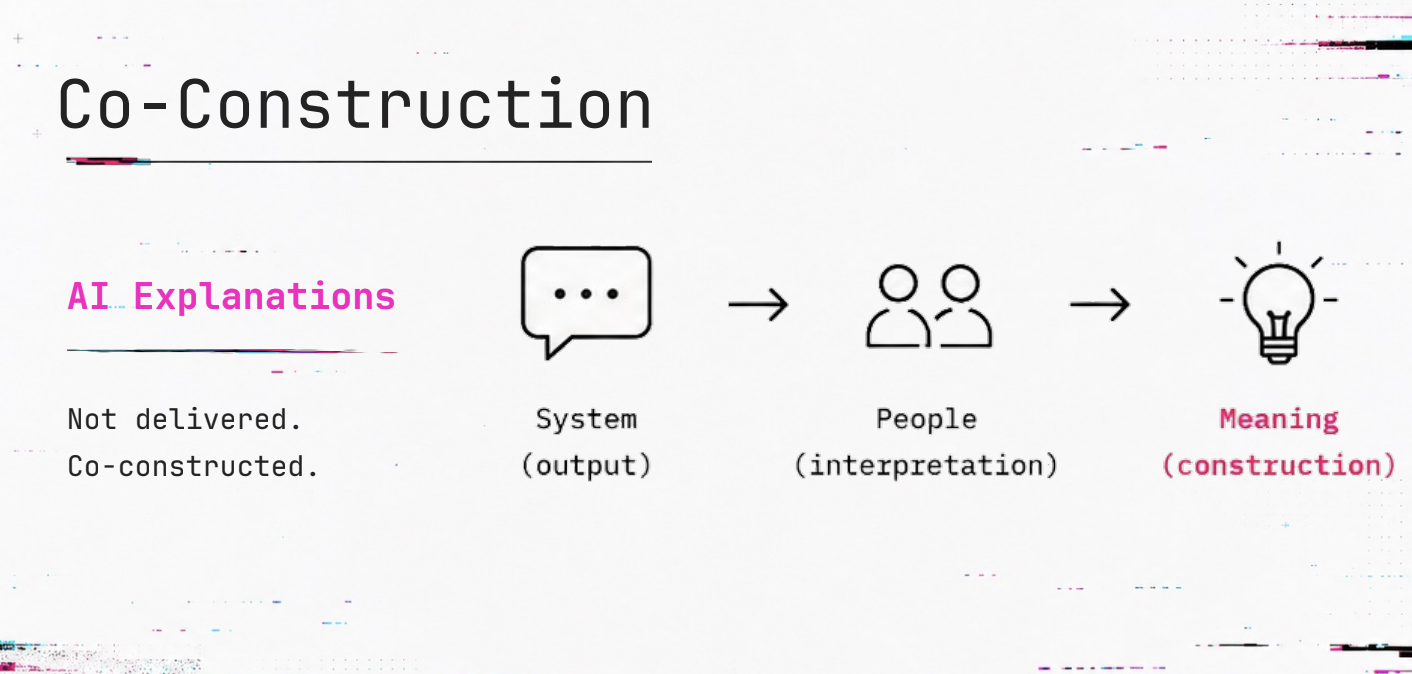
To explore this further, Dan’s research group has developed co-construction workshops, bringing people together to interrogate AI explanations collaboratively rather than receive them passively. In these workshops, participants are asked questions such as: “What counts as evidence? What is missing? What are the alternatives? Who benefits from this? Do we agree?”
To answer these questions, participants do not examine an AI model to find out how it generates a decision. Instead, participants scrutinise its outputs in the same way that they would critically evaluate a politician’s promise or a newspaper’s headline.
Dimensions for engaging critically with explanations
Critical Computational Literacy (CCL) is a framework that describes what people need to engage with AI explanations critically. Dan presented CCL as consisting of four interlocking dimensions:
- Attitude — a critical stance and value awareness: approaching computational systems not as neutral tools but as artefacts that embed particular values and assumptions
- Biography — recognising that people’s relationships with technology are shaped by subjectivity, by the varied encounters they’ve had with computational systems, and by the diverse pathways that brought them to this point
- Capacity — the analytical, creative, and ethical skills needed to actually work with and through computational systems, not just talk about them
- Critique — the capacity that ties the other three dimensions together: asking what matters, and why
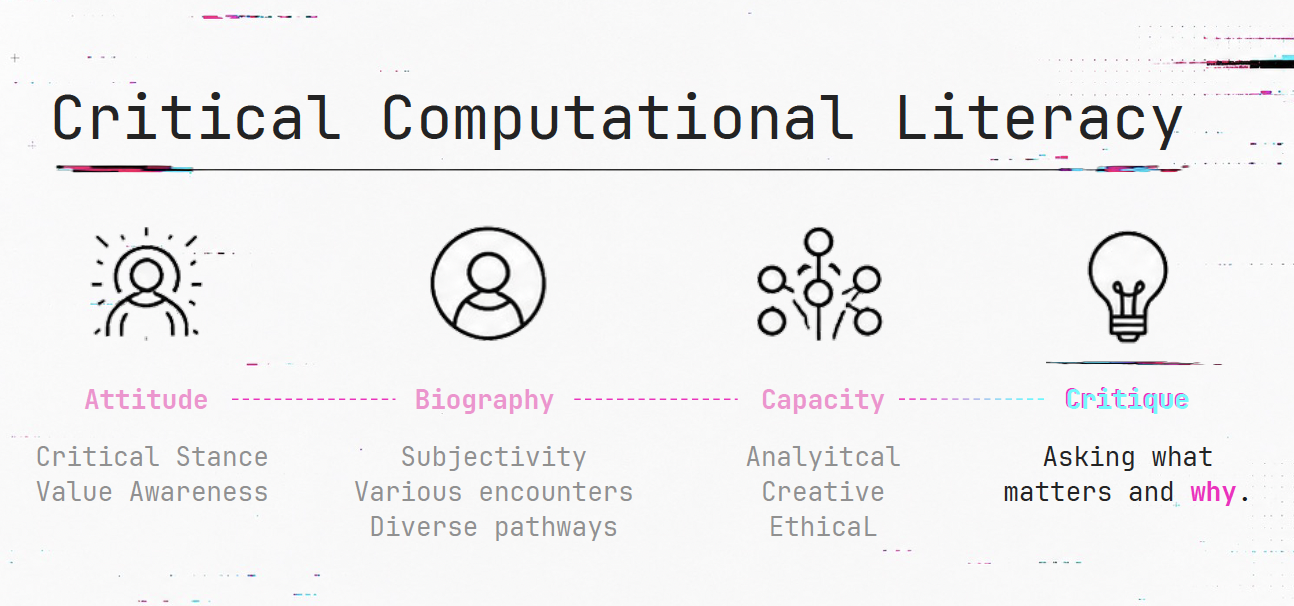
Taken together, these dimensions push back against a narrow, purely technical notion of ‘AI literacy’ as knowing how a model works. Instead, CCL treats literacy as something biographical and value-laden. Dan explained that individuals bring their own history and stance to any encounter with computational systems, and genuine literacy means being able to interrogate these systems’ explanations rather than simply accept or operate them.
Using these ideas in your classroom
Although Dan’s research took place with adult participants, Social XAI and Critical Computational Literacy are ideas that could also be used in the K-12 classroom. For example, if students interact with AI explanations through smart speakers or streaming recommendations in their everyday lives, this presents an opportunity to teach them how to engage critically with AI outputs. Students might explore why a smart speaker suggested a particular recipe, or investigate the explanation for why a streaming service recommended a particular show.
Explainability is also a key part of our own Experience AI resources. When training a model, students write their own model cards to document who built a model, what training data was used, how accurate the model’s predictions were, and any known limitations. In this activity, explainability is traceable, and students use their analytical skills to create transparent, fair, and accountable model cards.
Social XAI suggests an extension to this activity. Students could ask what matters about the explanation they have written and why this is important. Through this critique, students can consider who will read these model cards and how the cards might be interpreted. In this way, AI explanations become more than a technical output, and become artefacts whose meaning is co-constructed by the author and the reader.
This seminar was part of our ongoing series on teaching about AI in the arts, humanities, and sciences. You can watch the full recording of Dan’s talk, including the Q&A discussion, here:
Join our next seminar
Our research seminar series continues to explore how AI is taught across the curriculum. In our next seminar on Tuesday, 6 October at 19:00–20:30 BST, we welcome Eleni Petraki and Damith Herath (University of Canberra) who will present an engineering and robotics curriculum aimed at equipping future engineers with the diverse skills demanded by a growing workforce. To take part in the seminar, click the button below to register. We hope to see you there.
The schedule of our upcoming seminars is available online. You can catch up on past seminars on the blog and on the previous seminars and recordings page.




No comments
Jump to the comment form