Our computing pedagogy
Looking for computing resources that are effective, evidence-based, and grounded in research?
Our resources are built on the latest findings in computing education, including our own academic research. Guided by twelve pedagogy principles, they reflect the most up-to-date understanding of how to teach and learn computing.
Pedagogy resources
Discover new computing pedagogy insights and approaches for your classroom teaching in our reports and Quick Read explainers.
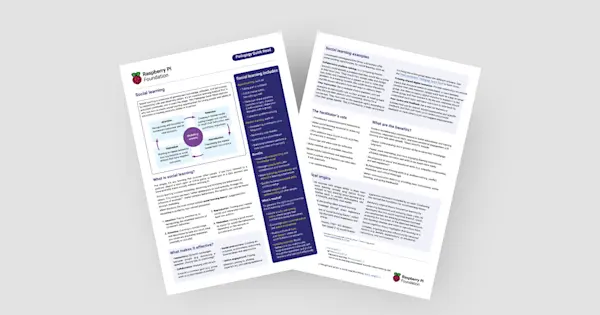
Quick Reads
Our Quick Reads are short, practical guides that help teachers put computing education research into practice. Each one addresses real issues teachers may encounter in the classroom.
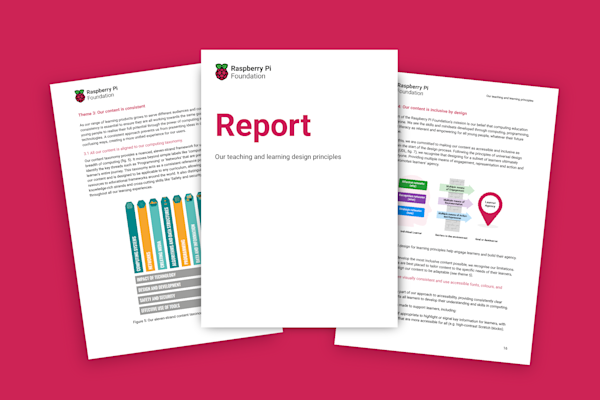
Reports
How each pedagogy principle is applied looks different in different contexts and for different areas of computing. Our topic reports explore big ideas and progression in different areas of computing, as well as relevant pedagogy principles and practices
Our pedagogy principles
Much of the work of the Raspberry Pi Foundation is underpinned by our twelve principles of computing pedagogy.

Add variety
Provide activities with different levels of direction, scaffolding, and support that promote active learning, ranging from highly structured to more exploratory tasks. Adapting your instruction to suit different objectives will help keep all learners engaged and encourage greater independence.

Challenge misconceptions
Use formative questioning to uncover misconceptions and adapt teaching to address them as they occur. Awareness of common misconceptions alongside discussion, concept mapping, peer instruction, or simple quizzes can help identify areas of confusion.
Create projects
Use project-based learning activities to provide learners with the opportunity to apply and consolidate their knowledge and understanding. Design is an important, often overlooked aspect of computing. Learners can consider how to develop an artefact for a particular user or function, and evaluate it against a set of criteria.
Foster program comprehension
Use a variety of activities to consolidate knowledge and understanding of the function and structure of programs, including debugging, tracing, and Parson’s Problems. Regular comprehension activities will help secure understanding and build connections with new knowledge.

Get hands-on
Use physical computing and making activities that offer tactile and sensory experiences to enhance learning. Combining electronics and programming with arts and crafts (especially through exploratory projects) provides learners with a creative, engaging context to explore and apply computing concepts.

Lead with concepts
Support learners in the acquisition of knowledge, through the use of key concepts, terms, and vocabulary, providing opportunities to build a shared and consistent understanding. Glossaries, concept maps, and displays, along with regular recall and revision, can support this approach.
Make concrete
Bring abstract concepts to life with real-world, contextual examples and a focus on interdependencies with other curriculum subjects. This can be achieved through the use of unplugged activities, proposing analogies, storytelling around concepts, and finding examples of the concepts in learners’ lives.
Model everything
Model processes or practices — everything from debugging code to binary number conversions — using techniques such as worked examples and live coding. Modelling is particularly beneficial to novices, providing scaffolding that can be gradually taken away.
Read and explore code first
When teaching programming, focus first on code ‘reading’ activities, before code writing. With both block-based and text-based programming, encourage learners to review and interpret blocks of code. Research has shown that being able to read, trace, and explain code augments learners’ ability to write code.

Structure lessons
Use supportive frameworks when planning lessons, such as PRIMM (Predict, Run, Investigate, Modify, Make) and Use-Modify-Create. These frameworks are based on research and ensure that differentiation can be built in at various stages of the lesson.

Unplug, unpack, repack
Teach new concepts by first unpacking complex terms and ideas, exploring these ideas in unplugged and familiar contexts, then repacking this new understanding into the original concept. This approach (semantic waves) can help learners develop a secure understanding of complex concepts.
Work together
Encourage collaboration, specifically using pair programming and peer instruction, and also structured group tasks. Working together stimulates classroom dialogue, articulation of concepts, and development of shared understanding.
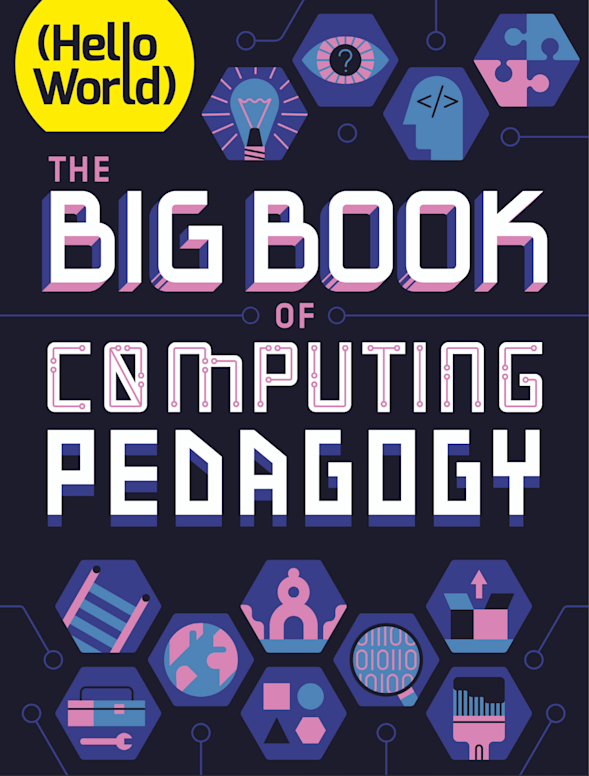
The Big Book of Computing Pedagogy
Our Hello World special edition on pedagogy is structured around our twelve pedagogy principles and describes a range of tried-and-tested approaches to teaching computing.
Take a look inside