Research seminars
We host free online seminars on current computing education research topics. Speakers from around the world present their work in the field.
This is your opportunity to learn from the latest research insights, make connections with fellow educators and researchers, and take part in discussions.
Get research seminar updates
Our next research seminar
"Developing competencies for the future of data and computing: The role of K–12"
When: 12th May @ 17:00 - 18:30 (BST)
Speaker: Shuchi Grover (Raspberry Pi Foundation)
Subject: In this seminar, Shuchi Grover will share key ideas from the US National Academies of Sciences, Engineering, and Mathematics (NASEM) report, which identifies seven shared competencies for data and computing and how they align with existing STEM standards and classroom practice. She will present examples of what such integration might look like, focusing on the overlaps with the Applied AI themes of the current seminar series, and outline how the K-12 CS and AI education communities might take guidance from this report.
Speaker bio: Shuchi Grover is the Director of Research and Impact at the Raspberry Pi Foundation. She is a computer scientist and learning scientist with over 20 years’ experience in PK–12 computing education in formal and informal settings.
Note: see below for the full seminar description and speaker bio.
Register for freeOur seminars: Applied AI / Teaching about AI across the curriculum
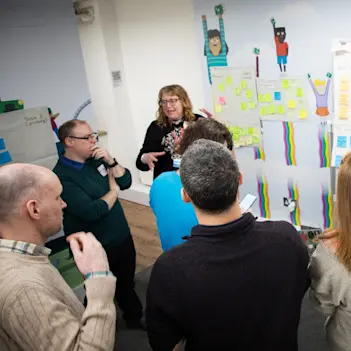
Our 2026 seminar series shifts the lens on AI education, exploring research on teaching and learning about AI from disciplines beyond computer science, including the arts, sciences, and humanities.
Seminars take place on the first Tuesday of each month at 17:00–18:30 BST / 12:00–13:30 EDT / 9:00–10:30 PDT / 18:00–19:30 CST.
12 May 2026: Shuchi Grover (Raspberry Pi Foundation)
Developing competencies for the future of data and computing: The role of K–12
The rapidly changing landscape of computing, information, and communications technologies has catapulted us into the era of big data, AI, and machine learning. Skills in computing and data are critical for all students to thrive in a data-driven world. While efforts to expand learning in these areas have grown, opportunities to participate are unevenly distributed and lack coherence across grades and subjects. A new report from the US National Academies of Sciences, Engineering, and Mathematics (NASEM) identifies seven shared competencies for data and computing and how they align with existing STEM standards and classroom practice. This seminar shares key ideas from this report, presents examples of what such integration might look like, focusing on the overlaps with the Applied AI themes of the current seminar series, and lastly, outlines how the K-12 CS and AI education communities might take guidance from this report.
Dr Shuchi Grover is the Director of Research and Impact at the Raspberry Pi Foundation. She is a computer scientist and learning scientist with over 20 years’ experience in PK–12 computing education in formal and informal settings. She has led several National Science Foundation-funded projects involving the research and design of curricula, assessments, tools, and environments that help develop 21st-century competencies in computing, data science, AI, and cybersecurity, as well as the integration of STEM, computer science, and data science. Shuchi served on the committee for the NASEM report on ‘Developing competencies for the future of data and computing: The role of K–12’.
16 June: Gianfranco Polizzi (University of Birmingham)
This presentation draws on relevant research and evidence to examine the concept of media literacy and its importance in the age of AI, while also considering related and overlapping concepts such as AI literacy. Persistent gaps in media literacy across the UK population will be highlighted, along with some of the challenges involved in equipping both children and adults with the skills they need to thrive in a rapidly changing digital society. Some evidence‑based recommendations for future research, policy, and practice will also be presented.
Dr Gianfranco Polizzi is an Assistant Professor in the Department of Linguistics and Communication at the University of Birmingham. His research examines how different groups develop and deploy the skills and knowledge they need to navigate online risks and opportunities and to participate in a digital society. His academic interests include media and digital literacy, media education, digital resilience, digital inequalities, digital citizenship, civic engagement and democracy. Gianfranco is currently co‑leading a Nuffield‑funded project examining the effectiveness of media literacy pedagogies on the wellbeing of secondary students, as well as a project funded by the Institute for Data and AI exploring AI use among young people aged 18–25 in relation to their mental health and wellbeing. He is a member of Ofcom’s Making Sense of Media Research, Evidence and Evaluation working group, providing advice on media and digital literacy research and provision in the UK. In addition, he sits on the Academic Advisory Group of the All‑Party Parliamentary Group (APPG) on Political and Media Literacy, run by Shout Out UK.
14 July: Dan Verständig (Goethe University Frankfurt)
On critique as practice and critical computational literacy
Digital tools have increasingly been subjected to critique that exposes their biases, power dynamics, and societal implications. In consequence, educational research and interdisciplinary scholarship are not only challenged to engage with what it means to be “critical,” but also to reflect on critique itself. As computational technologies and algorithmic systems become woven into educational and civic infrastructures, the task is no longer merely to analyse their effects, but to develop frameworks that also reimagine technology’s role in education and society.
Against this background, this talk draws on historical perspectives on the relationship between romanticism and technology and argues that, together, art and science offer productive ways to overcome misconceptions about technology and to cultivate critique as practice. Romantic framings such as innovation as destiny, artificial intelligence as “mind,” or progress as inherently beneficial do not simply simplify complex systems; they shift responsibility and render political choices as technical inevitabilities. The talk proposes Critical Computational Literacy (CCL) as an educational response that treats computational systems as shaped by cultural, historical, and normative assumptions, rather than as neutral tools with the aim of supporting imagination, agency, participation and accountable educational practices in datafied worlds.
Dan Verständig is Professor of Educational Theory and Practices of Critical Computational Literacy at the Center for Critical Computational Studies (C3S), Goethe University Frankfurt. His research addresses learning in the context of digitality, with a focus on inequality, civic participation, and creative-critical approaches to coding and data literacy. He is a founding member of the Critical Big Data and Algorithmic Literacy Network (CBDALN) and works with experimental formats such as interactive installations, data-driven art, and playful methods to make digital infrastructures visible and reflect on their societal implications. He also advises NGOs on digital literacy and information security.
8 September: Jie Chao (The Concord Consortium)
More information coming soon.
6 October (7–8:30 pm BST): Eleni Petraki and Damith Herath (University of Canberra)
Advancing robotics education: directions for school and tertiary contexts
Robotics has long fascinated researchers and learners alike, and its significance has grown exponentially with the rise of artificial intelligence and automation in everyday life. This webinar explores the evolution of robotics education within STEAM disciplines, highlighting historical developments and current innovations that address the field’s multidisciplinary nature. While historically fields such as Artificial Intelligence, computer science and robotics were distinct disciplines, research is pointing to pedagogical approaches for integrated STEAM pedagogies. Drawing on the research within the first truly interdisciplinary textbooks (Herath and St-Onge, 2022), we illustrate the redesign of an engineering and robotics curriculum from an Australian tertiary course aimed at equipping future engineers with the diverse skills demanded by a growing workforce. The session concludes with evidence-based recommendations for best practices in robotics pedagogy, emphasising theory-driven methods and interdisciplinary learning approaches.
Eleni Petraki is an Associate Professor in Curriculum Design and Human–AI Education in the Faculty of Education at the University of Canberra. She has over 26 years of experience in language teaching and teacher education, spanning curriculum design, educational research, and applied linguistics. Eleni was a Chief Investigator and recipient of an ARC Discovery National Competitive Grant (2020–2025) in the field of machine education and artificial intelligence. Her research focuses on curriculum design, education for human–AI collaboration, artificial intelligence in education, and interaction analysis and communication.
Damith Herath is a Professor of Robotics and Art at the University of Canberra and leads the Collaborative Robotics Lab, a multidisciplinary research team with strong industry partnerships. An award-winning entrepreneur and a roboticist, Professor Herath has over two decades of experience leading complex robotic integration projects. In 2011, he founded Australia's first collaborative robotics startup, which was recognised as one of Australia's most innovative young tech companies in 2014. Professor Herath has also chaired several international workshops on Robots and Art and is the lead editor of the seminal book "Robots and Art: Exploring an Unlikely Symbiosis," a significant contribution to the field featuring leading roboticists and artists.
10 November: Doreen Boyd (University of Nottingham)
More information coming soon.
Catch up on previous seminars
We have had the privilege to learn from many incredible researchers since we started our seminars in 2020, and we're excited to share their talks with you. Explore the archives below to watch and read about past seminars.
Seminar recordings
We make the seminar talks available to watch after they take place. Discover recordings from our current and previous series on programming; primary (K–5) computing; cross-disciplinary computing; artificial intelligence; and equity, diversity and inclusion.
Summaries on the blog
After each seminar, we publish a short blog to sum up some of its main take-aways and share the video recording of the speaker's talk. Each blog highlights how the seminar applies to teachers' classroom practice. Browse the archive of seminar blogs.