
Hello World Podcast
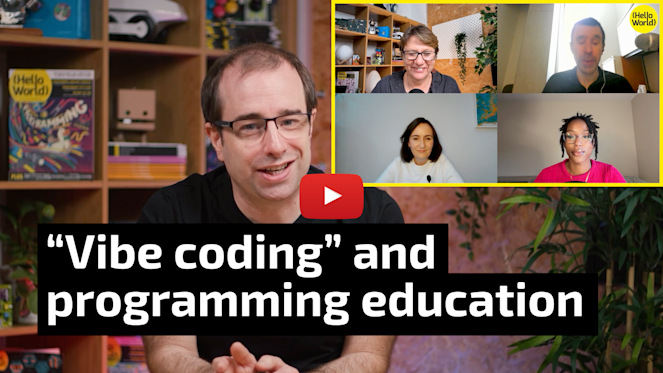
Does “Vibe Coding” have a role in programming education?
In this episode we ask whether “vibe coding" has a role in programming education? We hear from a university academic, a secondary school teacher, and a student, who have each investigated using AI tools to support students learning to program.
‘‘Vibe Coding’’ is a new term most associated with how professional programmers might quickly create prototypes using AI tools in a fast and iterative way. But learning to program, particularly for school-aged learners, is very different to developing IT solutions. We will talk to a university academic, a secondary school teacher and a student who have each investigated using AI tools to support students learning to program. We ask what role might Vibe Coding, a software engineering approach, bring to the complicated job of young people learning how to program?
Meet our guests

Jane Waite
Jane is the senior research scientist at the Raspberry Pi Foundation. She leads the research team that explores teaching school-aged learners about AI and how they might learn to program with AI. Jane is a visiting academic at the Raspberry Pi Computing Education Research Centre at the University of Cambridge.

Jedidah Ajala
Jedidah Ajala is a first-year Computer Science student at the University of Edinburgh (UoE). During her final year of secondary education (2024/25), Jedidah contributed significantly to a computing education study at UoE. Jedidah's academic interests centre on the intersection of computer science and ethics.

Irene Stone
Irene is a doctoral researcher at Dublin City University, focusing on generative AI and introductory programming. She has over 20 years’ experience teaching Computer Science and Mathematics at second level. She has also helped support the professional learning of teachers of the Leaving Certificate Computer Science subject.

Daniel Zingaro
Dr. Daniel Zingaro is a Teaching Professor at the University of Toronto. He is the recipient of several awards including the SIGCSE 50th Anniversary Top Ten Symposium Papers of All Time Award. He co-Directs the GenAI in CS Education Consortium, and has written several books on programming.
Does "vibe coding" have a role in programming eduction?
If you prefer to listen to your podcasts, you can access our episodes via your preferred streaming platform.
About us
For insights into teaching and learning from classrooms all around the world, check out and subscribe to Hello World magazine. If you've enjoyed this episode and are excited for the upcoming series, please subscribe and leave a five-star review wherever you get your podcasts.
In this episode, educators discuss the pros and cons of using Scratch, Python, Java and other programming languages to teach coding skills at different learning stages. In the meantime, you can get in touch with your questions or comments about the current episode at podcast@helloworld.cc. If you can, please take a moment to give us some feedback on this episode or our podcast generally.
Useful links
Subscribe to Hello World magazine
Find out more about the charitable mission of the Raspberry Pi Foundation
Explore the topic of Programming further and download Issue 28 today
Download our special issues, The Big Book of Computing Pedagogy and The Big Book of Computing Content
Write for us — simply share your idea and we'll help you see it published in a future Hello World issue
Find out about the research done by the Raspberry Pi Computing Education Research Centre on teaching about AI and teaching programming with AI.
Watch our free online research seminars to hear about the latest computing education research and insights from speakers around the world.
Read Jedidah's co-authored research paper.
Find out more about Jedidah's by visiting her website
Find out more about Daniel by visiting his website
Explore the GenAI in CS Education Consortium